Learn the essentials of Singapore’s SAFE framework, the enhanced grading system that strengthens food safety standards and helps consumers make informed dining choices. This system grades food establishments based on their safety track records, with added requirements for higher‑risk businesses and a structured WSQ training pathway for food handlers and hygiene officers.
Enquire Now- Overview
- Phase 1
What is the SAFE framework?
The SAFE framework is an improved grading of food establishments based on their food safety track records and implementation of food safety management systems with the appointment of a competent person (Advanced Food Hygiene Officer).
Food establishments with consistent good food safety track records will attain higher grades, while those with poor food safety track records will attain lower grades, and be subjected to more frequent inspections.
In addition, establishments involved in significant processing or preparation of food (such as food manufacturers and caterers) will need to meet additional requirements to appoint an Advanced Food Hygiene Officer (AFHO) and implement a Food Safety Management System (FSMS) to maintain or attain grade ‘A’.
The SAFE framework will be implemented in two phases. Phase 1 came into effect on 19 January 2026, while more details on the implementation of Phase 2 will be announced by 2027.
Training Course for Food Handlers and Food Hygiene Officers
To support and complement the SAFE framework, SFA has implemented a training framework. The Food Safety Courses (FSC) are organised into four levels:
WSQ Food Safety Course Level 1
Level 1 of the FSC covers basic food safety principles for food handlers.
WSQ Food Safety Course Level 2
WSQ Food Safety Course Level 2 is intended for upskilling of food handlers, who will receive additional training on conducting food safety checks at their specific work areas. Find out more about the Food Safety Level 2 course.
WSQ Food Safety Course Level 3
(Food Hygiene Officers)
Level 3 of the FSC will equip Food Hygiene Officers (FHO) with the knowledge to implement food safety pre-requisite programmes and basic principles of HACCP and Food Safety Management System (FSMS).
A Food Hygiene Officer (FHO) is a supervisory personnel who will assist the licensee to put in place, monitor and maintain a proper food safety system. They will conduct regular checks and educate and remind food handlers to adhere to good food safety practices and personal hygiene during food preparation. Currently, the food establishments listed below are required to appoint a FHO for each premises before issuance of licence.
FHOs are required to attend and pass the WSQ Food Safety Course (FSC) Level 3. FHOs (e.g., in retail food establishments) who have passed the former WSQ Conduct Food and Beverage Hygiene Audit Course* or have been previously trained under the FHO course* conducted by Singapore Environment Institute (SEI) will continue to be recognized by SFA.
Find out more about the Food Safety Level 3 Course (Food Hygiene Officer Course)
WSQ Food Safety Course Level 4 (Advanced Food Hygiene Officers)
Level 4 of the FSC are for FHOs to become Advanced FHOs — the course will cover the implementation of FSMS and how to conduct broader food safety checks and internal audits.
An Advanced Food Hygiene Officer (FHO) is supervisory personnel who establishes and oversees food safety standards of their food establishment by developing, implementing and managing a Food Safety Management System (FSMS). Advanced FHOs also conduct internal audits of the FSMS and address potential non-compliances with SFA’s regulations.
Supervisory personnel who have passed the former WSQ Apply Food Safety Management Systems for Food Service Establishments Course* or WSQ Food Safety Course (FSC) Level 4 can be appointed as an Advanced FHO.
For more information, please refer to https://www.sfa.gov.sg/food-retail/food-safety-management-system. *This course has been replaced by WSQ FSC Level 4.
What is the purpose of the SAFE framework?
The SAFE framework promotes maintaining high food safety standards within the food industry to foster and strengthen consumer confidence. By checking SAFE grades, consumers are empowered to make wiser dining decisions and support establishments committed to food safety.
Ensuring food safety is a shared responsibility, and everyone can contribute to enhancing these standards in Singapore.
What types of food establishments does the SAFE framework apply to?
The SAFE framework applies to SFA-licensed food establishments that process or prepare food for sale to the public. These food establishments are grouped into two categories.
Licensees can check their establishment category by scanning the QR code on their SFA licence to access their business trade description, then matching this description with the establishments listed in the tables below.
Category 1 Food Establishments
These include restaurants with kitchen size of 16m² or more, caterers, central kitchens and food manufacturing premises, whose establishments are involved in significant processing or preparation of food. More details are in the table below.
| Category 1 Food Establishments | |
| Restaurants & Catering Services | – Food Caterers – Restaurants with kitchen size 16m² or more – In-house kitchens – Restaurants with catering – Canteens with catering |
| Food Manufacturing & Processing | – Food Processing – Establishments – Slaughterhouses |
Category 2 Food Establishments
These include restaurants with kitchen size less than 16m², cold stores, takeaway outlets, supermarkets, and food stalls in coffee shops, canteens, food courts and hawker centres, whose establishments engage in low/moderate levels of food processing or preparation. More details are in the table below.
| Category 2 Food Establishments | |
| Retail Food Shops | – Bakeries – Pubs, Bars, Nightclubs, Discos – Cloud Kitchens – Takeaway outlets – Restaurants with kitchen size less than 16m² |
| Mobile Food Services | – Food Vending Machines – Mobile Food Wagons – Food Carts (Take Away) |
| Food Stalls | – Coffeeshops – Eating houses – Canteens – Food courts – Hawker stalls |
| Others | – Cold Stores – Food Processing Establishments (Cloud Kitchen Operators) – Supermarkets |
How are the grades determined under the SAFE framework?
In the current Phase 1, SAFE grades are determined by the food safety track record of the food establishments. All food establishments under the SAFE framework have been assigned a starting grade based on their current food safety track records.
In Phase 2, there will be additional requirements for Category 1 food establishments to maintain or attain grade ‘A’. Category 2 food establishments will continue to be graded based on their food safety track records. More details on the implementation of Phase 2 will be announced by 2027.
Information source : Safety Assurance for Food Establishment (SAFE) Framework
For more information about our F&B related courses, go to F&B Courses.
Phase 1 (from 19 January 2026)
Existing food establishments have been assigned a starting grade under the SAFE framework based on their current food safety track records. New establishments with less than 1 year of operation will begin with a ’NEW’ grade.
The track record starts from the date that the licence was issued or the day after the date of the last major lapse (e.g. licence suspension under the Points Demerit System for retail food establishments or court conviction for food safety offences).
Fast-track* option is available for Category 1 food establishments to attain grade ‘A’ in shorter time. They must have a 1-year good food safety track record, appoint an Advanced Food Hygiene Officer (AFHO) and implement a certified FSMS. There is no fast-track option for Category 2 establishments.
SAFE grades will be updated based on food establishments’ food safety track records. For instance, if a food establishment commits a major lapse, it will be immediately downgraded to grade ‘C’, regardless of the present grade.
*Not applicable for food establishments with grade ‘C’ track record (i.e., committed major lapse)
| Category 1 Food Establishments | Category 2 Food Establishments |
| Grade A: Good track record (i.e. no major lapse) for more than three years Fast-track to grade ‘A’ if establishment has: – One-year good track record – Appointed AFHO – Implemented certified FSMS | Grade A: Good track record (i.e. no major lapse) for more than three years No fast-track option |
| Grade B: Good track record (i.e. no major lapse) of between one to three years | Grade B: Good track record (i.e. no major lapse) of between one to three years |
| NEW: In operation for less than one year | NEW: In operation for less than one year |
| Grade C: Committed major lapse (e.g. court conviction or suspension of licence under the Points Demerit System) regardless of present grade | Grade C: Committed major lapse (e.g. court conviction or suspension of licence under the Points Demerit System) regardless of present grade |
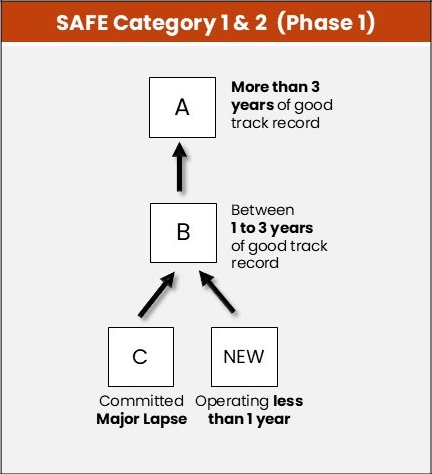
Note: A major lapse is defined as either a licence suspension under the Points Demerit System (for retail food establishments which have accumulated 12 demerit points within 12 months) or a court conviction for food safety offences.
What is the role of an Advanced Food Hygiene Officer?
An Advanced Food Hygiene Officer (AFHO) is a supervisory personnel member who develops and implements a FSMS. AFHOs also conduct internal audits to ensure that the FSMS is implemented correctly and address potential non-compliances with SFA’s regulations.
To be appointed as an AFHO, supervisory personnel must have passed either:
- Workforce Skills Qualification (WSQ) Food Safety Course (FSC) Level 4, or
- Former WSQ Apply Food Safety Management Systems for Food Service Establishments Course*
*This course has been replaced by WSQ FSC Level 4.
Subsidies for WSQ courses are available through SkillsFuture Singapore. Contact the training providers directly to learn more about the application processes and course details.
For more information on AFHOs, see Requirements for Food Hygiene Officers and WSQ Food Safety Course (FSC) Level 4.
